import seaborn as sns
import matplotlib.pyplot as plt

sns.barplot(x=[0, 1, 2, 3, 4], y=[1/4, 0, 1/2, 0, 1/4])
plt.xlabel('Payoff')
plt.ylabel('Probability')
Text(0, 0.5, 'Probability')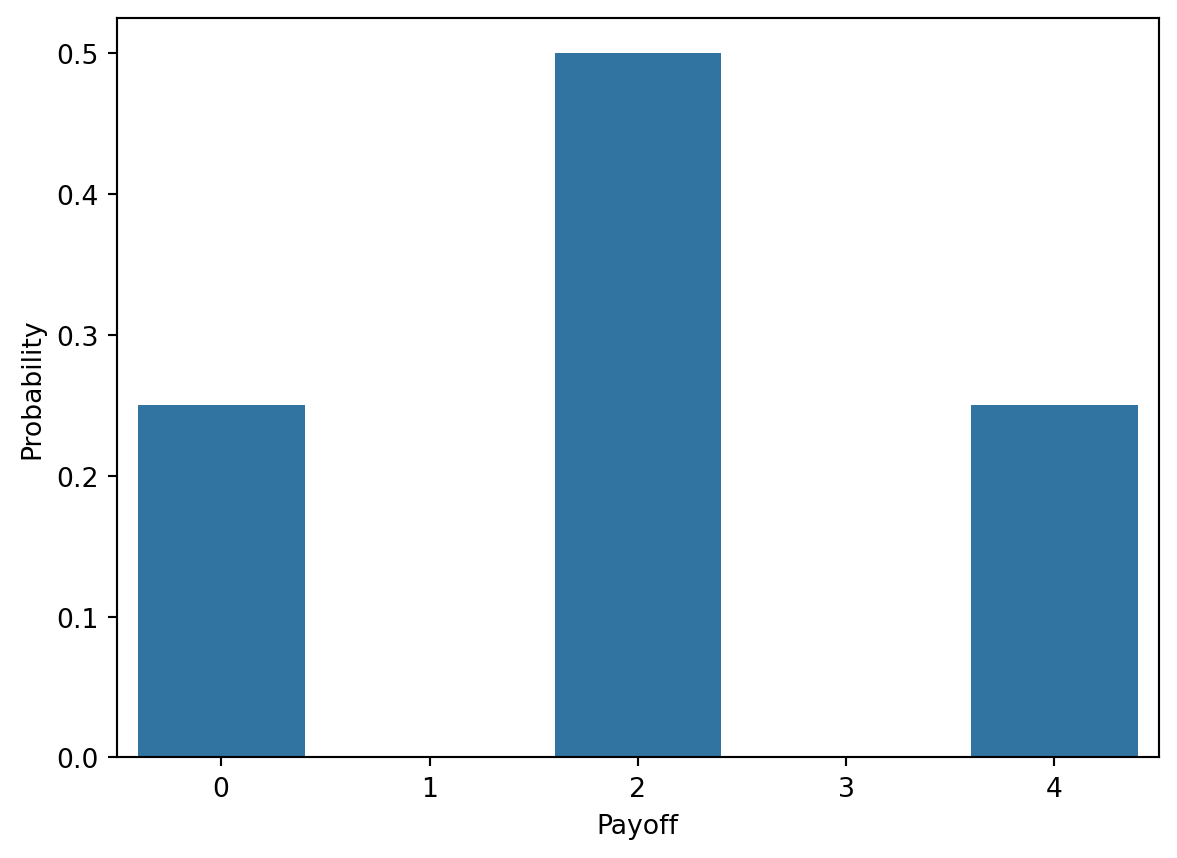
Open in Google Colab: 
Until now we have been looking at experiments (games) where the outcome of the game is uncertain and have seen how we can calculate probabilities of events associated with these games. For example, we counted the number of ways to get a sum greater than 10 when rolling two dice (Exercise 6.1), assumed a probability model for the dice rolls (equally likely outcomes), and calculated the probability of the event of interest.
In this section, we will look at functions that map the outcomes of an experiment to a real number. For simplicity, consider an experiment of tossing two coins and a game where you win 2 EUR for every head. In this game your payoff is a function of the outcome of the experiment and so you can compute the probability of winning a given amount of money.
The sample space of the experiment is
\Omega = \{HH, HT, TH, TT\}
where H denotes heads and T denotes tails. Let w be an outcome in the sample space \Omega. The payoff function X(w) is defined as follows:
X(\omega) = \begin{cases} 0 & \text{if } \omega = TT \\ 2 & \text{if } \omega = HT \text{ or } \omega = TH \\ 4 & \text{if } \omega = HH \end{cases}
If we equip the sample space with a probability model, we can compute the probability of winning 0, 1, or 2 EUR. Let’s assume that the outcomes are equally likely (our probability model), so that the probability of each outcome in \Omega is 1/4. Then the probability of winning nothing is
P(X = 0) = P(\{TT\}) = \frac{1}{4}
the probability of winning 2 EUR is
P(X = 4) = P(\{HH\}) = \frac{1}{4}
and the probability of winning 1 EUR is
P(X = 2) = P(\{HT, TH\}) = \frac{2}{4} = \frac{1}{2}
With these three probabilities we have a complete description of this game. We call the function f(x) that maps the possible payoffs to their probabilities the probability mass function (PMF) of the random variable X. In this case, the PMF is very simple:
f(x) = \begin{cases} \frac{1}{4} & \text{if } x = 0 \\ \frac{1}{2} & \text{if } x = 2 \\ \frac{1}{4} & \text{if } x = 4 \\ 0 & \text{otherwise} \end{cases}
import seaborn as sns
import matplotlib.pyplot as plt
sns.barplot(x=[0, 1, 2, 3, 4], y=[1/4, 0, 1/2, 0, 1/4])
plt.xlabel('Payoff')
plt.ylabel('Probability')Text(0, 0.5, 'Probability')# Simulate the game
import numpy as np
# We use 0 to represent heads and 1 to represent tails
coins_game = np.random.choice([0, 1], size=[1000, 2])# The payoff is equal to the sum of the 0s and 1s in each row (game) times 2
payoff = 2 * np.sum(coins_game, axis=1)sns.displot(x=payoff, stat='probability')
plt.xlabel('Payoff')
plt.ylabel('Proportions')Text(9.066666666666666, 0.5, 'Proportions')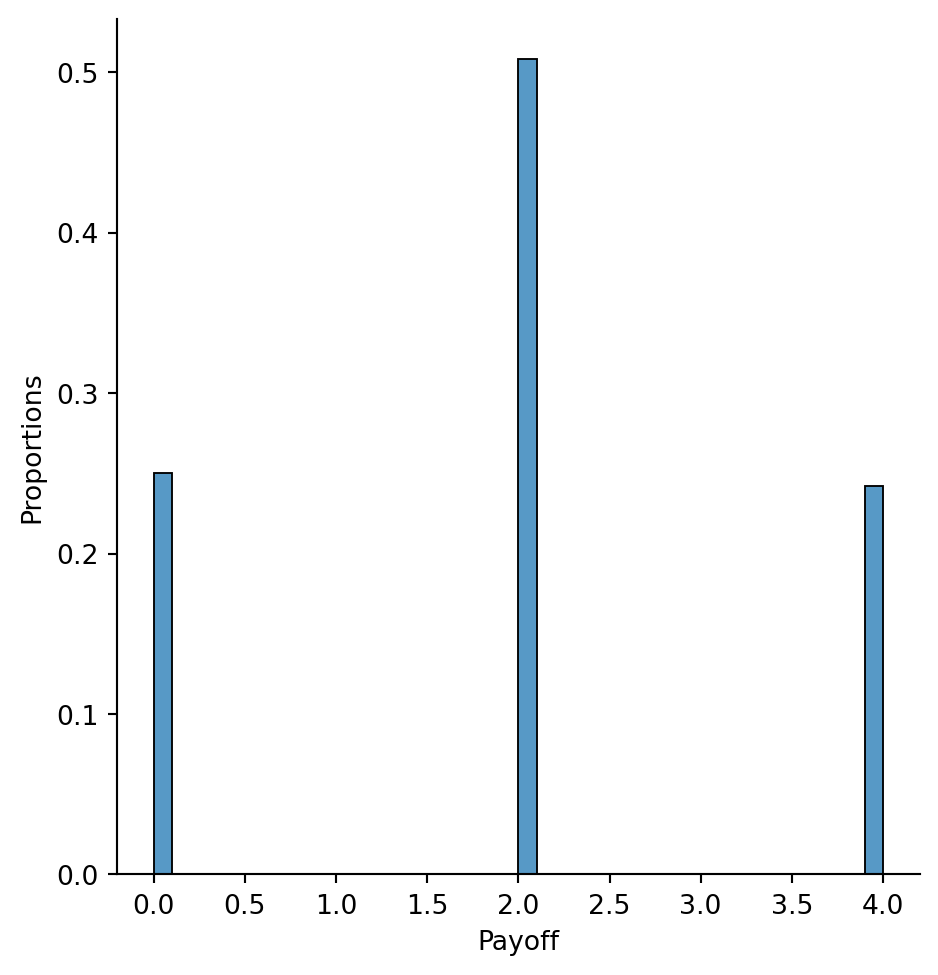
Definition 8.1 (Probability Mass Function) For a discrete random variable X, the probability mass function (PMF) maps each possible value of X to its probability. The PMF is denoted by f(x) and satisfies the following properties:
Exercise 8.1 (The Binomial Distribution (1)) Consider an experiment where you toss a coin 3 times independently. Write down the sample space \Omega as a set of sequences (e.g., HHH for three heads). Let X be the random variable that counts the number of heads in the sequence. Write down the PMF of X.
The sample space is
\Omega = \{HHH, HHT, HTH, HTT, THH, THT, TTH, TTT\}
and has 2^3 = 8 elements. The random variable X is defined as the number of heads in the sequence. Under a probability model of equally likely outcomes the PMF of X is
f(x) = \begin{cases} \frac{1}{8} & \text{if } x = 0 \\ \frac{3}{8} & \text{if } x = 1 \\ \frac{3}{8} & \text{if } x = 2 \\ \frac{1}{8} & \text{if } x = 3 \\ 0 & \text{otherwise} \end{cases}
Before we move on, let’s look at the counting argument that leads to this PMF. We have obtained the PMF by counting the number of sequences that have x heads and summing their probabilities (because they are disjoint events). For example, the probability of getting 1 head is the sum of the probabilities of the sequences HTT, THT, and TTH. We can generalize this by asking the following questions:
Therefore, the number of sequences with no heads is
\binom{3}{0} = \frac{3!}{0!3!} = 1
Therefore, the number of sequences with one head is
\binom{3}{1} = \frac{3!}{1!2!} = 3
Therefore, the number of sequences with two heads is
\binom{3}{2} = \frac{3!}{2!1!} = 3
Therefore, the number of sequences with three heads is
\binom{3}{3} = \frac{3!}{3!0!} = 1
Exercise 8.2 (The Binomial Distribution (2)) Consider a similar experiment as in Exercise 8.1 but this time you toss the coin not 3 but n times independently. A random variable X counts the number of heads in each sequence. Under a fair coin model all sequences in the sample space \Omega are equally likely. Write down the PMF of X.
The sample space consists of all sequences of length n with heads and tails. There are 2^n elements in the sample space.
\Omega = \{(e_1, e_2, \ldots, e_n) | e_i \in \{H, T\}, i = 1,\ldots n \}
The random variable X counts the number of heads in each sequence. As all sequences are equally likely and the outcomes are mutually exclusive, we obtain the PMF of X by counting the number of sequences with x heads and dividing by the total number of sequences.
As in the exercise Exercise 8.1, consider a sequence of length n with x heads.
Therefore, the number of sequences with x heads is
\binom{n}{x} = \frac{n!}{x!(n - x)!}
The probability of each sequence is 1/2^n and so the PMF of X is
f(x) = \binom{n}{x} \left(\frac{1}{2}\right)^n
Exercise 8.3 (The Binomial Distribution) In this exercise we will again consider a coin tossing experiment where you toss a coin n times independently, but this time the coin will not be fair. Instead the probability of getting a head is p and the probability of getting a tail is 1 - p. Write down the PMF of the random variable X that counts the number of heads in each sequence.
As in the previous two examples the sample space consists of all sequences of length n with heads and tails. For a sequence of length n with x heads, the number of sequences is
\binom{n}{x}
The only difference is that the sequences are not equally likely anymore. We still assume that the tosses are independent.
Because of independence, the probability of a sequence with x heads is
p^x (1 - p)^{n - x}
The PMF of X is then
f(x) = \binom{n}{x} p^x (1 - p)^{n - x}
import numpy as np
from scipy.stats import binom

x = np.arange(0, 7)
y = binom.pmf(x, n=6, p=0.3)

sns.barplot(x=x, y=y)
plt.xlabel('Number of successes')
plt.ylabel('Probability')
Text(0, 0.5, 'Probability')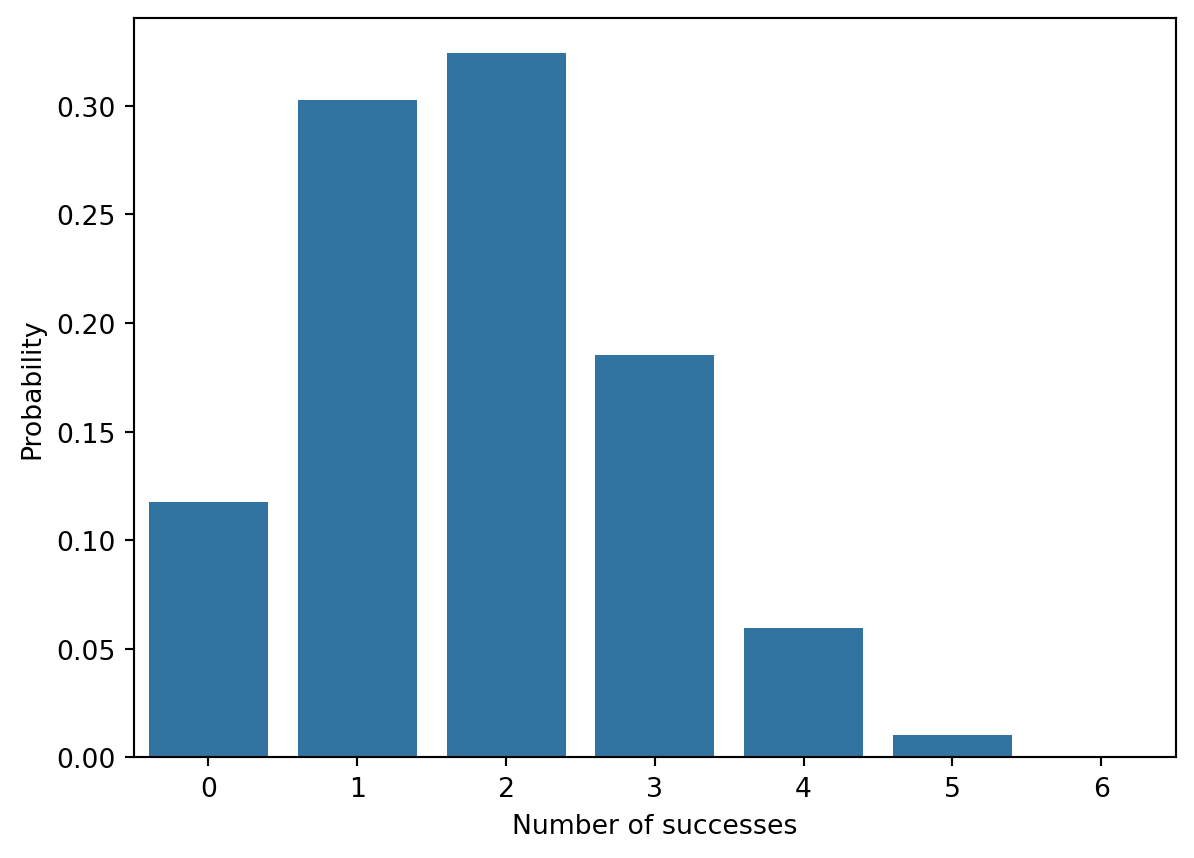
# Simulate the binomial distribution with n=6 and p=0.3

binomial = np.random.binomial(n=6, p=0.3, size=1000)

#| label: fig-binomial-epmf-simulated
#| caption: Empirical probability mass function of the binomial distribution with parameters n=6 and p=0.3.

sns.displot(x=binomial, stat='probability')
plt.xlabel('Number of successes')
plt.ylabel('Proportions')
Text(0.5666666666666655, 0.5, 'Proportions')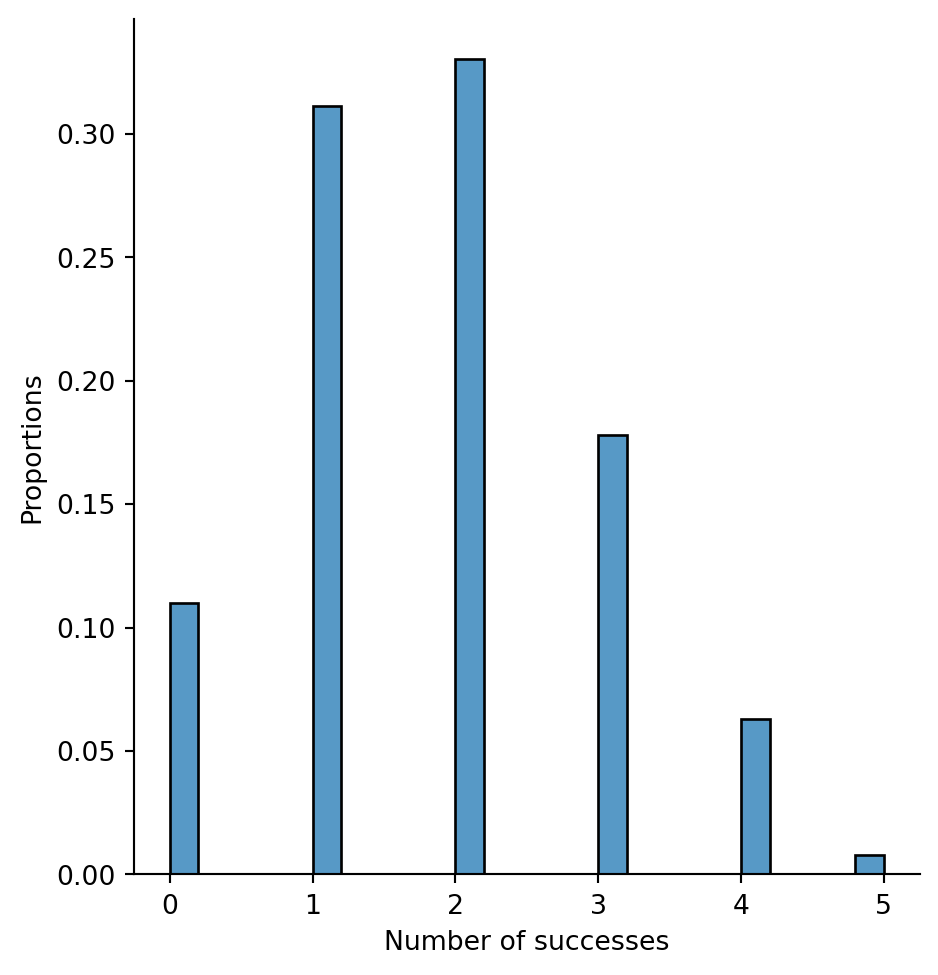
The probability mass function (PMF) of a random variable X gives the probability of each possible value of X. The cumulative distribution function (CDF) of X gives the probability that X is less than or equal to a given value x.
Definition 8.2 (Cumulative Distribution Function) For a discrete random variable X, the cumulative distribution function (CDF) is defined as
F(x) = P(X \leq x) = \sum_{y \leq x} f(y)
where f(y) is the PMF of X and the sum runs over all possible values of y that are less than or equal to x.
Exercise 8.4 (Properties of the CDF) Consider a discrete random variable X with PMF f(x) and CDF F(x). Show that the CDF satisfies the following properties:
Exercise 8.5 (CDF of the Coin Tossing Game) Consider our introductory example of the coin tossing game where you win 2 EUR for every head. Write down the CDF of the random variable X that counts the amount of money you win and use it to calculate the following probabilities:
The PMF of X is
f(x) = \begin{cases} \frac{1}{4} & \text{if } x = 0 \\ \frac{1}{2} & \text{if } x = 2 \\ \frac{1}{4} & \text{if } x = 4 \\ 0 & \text{otherwise} \end{cases}
The CDF of X is
F(x) = \sum_{y \leq x} f(y)
F(x) = \begin{cases} 0 & \text{if } x < 0 \\ \frac{1}{4} & \text{if } 0 \leq x < 2 \\ \frac{3}{4} & \text{if } 2 \leq x < 4 \\ 1 & \text{if } x \geq 4 \end{cases}
The probability of winning between 1.5 and 3 EUR is
P(1.5 \leq X \leq 3) = F(3) - F(1.5) + P(X = 1.5) = \frac{3}{4} - \frac{1}{4} + 0 = \frac{1}{2}
The probability of winning more than 2.5 EUR is
P(X > 2.5) = 1 - P(X \leq 2.5) = 1 - F(2.5) = 1 - \frac{3}{4} = \frac{1}{4}
The probability of winning between 2 and 6 EUR is
P(2 \leq X \leq 6) = F(6) - F(2) + P(X = 2) = 1 - \frac{3}{4} + 0 = \frac{1}{4}
sns.ecdfplot(x=payoff)
plt.xlabel('Payoff')
plt.ylabel('Proportion of games with payoff less than or equal to x')
Text(0, 0.5, 'Proportion of games with payoff less than or equal to x')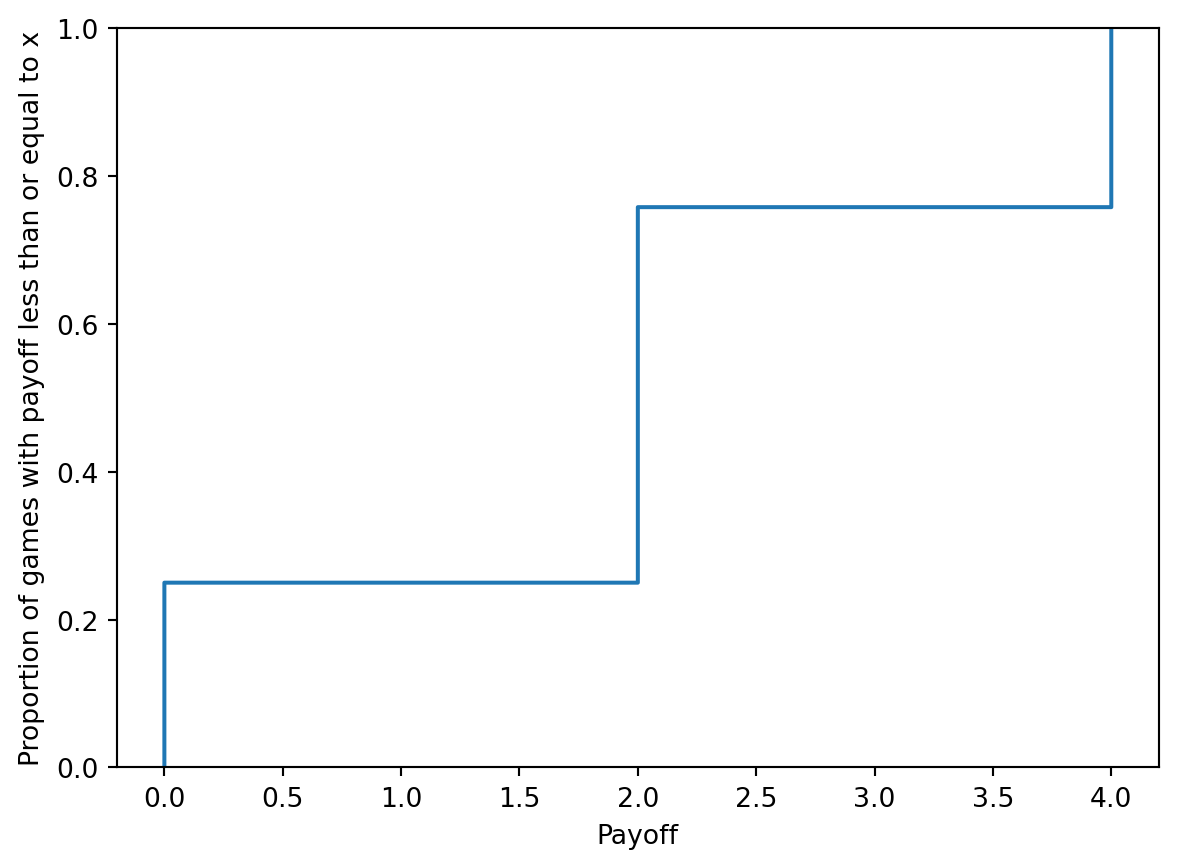
The statistical modeling of waiting times (e.g. number of hours or weeks until some event occurs) forms an important part of the applied work in statistics. Consider some examples:
Assuming that these events may occur in every period with a fixed probability and assuming independence between the periods, all of these examples
Exercise 8.6 (Coin Tossing until the First Head) You toss a biased coin with probability of getting a head p. Assume that the tosses are independent. The random variable X counts the number of tosses until the first head. Write down the PMF and CDF of X. Compute the following probabilities:
In the derivation of the CDF you will need an expression for the partial sum of a geometric series. The sum of the first n terms of a geometric series is:
\sum_{k = 0}^{n} r^k = \frac{1 - r^{n + 1}}{1 - r}, \quad r \neq 1
where r is the common ratio of the series. In this case, the common ratio is 1 - p.
It is easy to show why the above equation holds:
\begin{align*} S_n &= 1 + r + r^2 + \ldots + r^{n - 1} + r^{n} \\ rS_n &= r + r^2 + \ldots + r^{n} + r^{n + 1} \\ \end{align*}
Subtracting the second equation from the first gives
S_n - rS_n = 1 - r^{n + 1} \Rightarrow S_n = \frac{1 - r^{n + 1}}{1 - r}
# Check it with numpy

pwr = np.array([0, 1, 2, 3, 4, 5])
series = 0.5 ** pwr
series
array([1. , 0.5 , 0.25 , 0.125 , 0.0625 , 0.03125])# Look at the partial sums
np.cumsum(series)array([1. , 1.5 , 1.75 , 1.875 , 1.9375 , 1.96875])# Compare these to the result obtained using the formula
(1 - 0.5 ** (pwr + 1)) / (1 - 0.5)array([1. , 1.5 , 1.75 , 1.875 , 1.9375 , 1.96875])Exercise 8.7 (Light Bulb Burnout) A firm produces light bulbs that burn out after a random number of months. As the firm is issuing a warranty, it is interested in the distribution of the number of months until a bulb burns out, because this will determine the number of replacements it has to provide. The analytics department of the firm has estimated that each bulb is likely to burn out with a probability of 0.02 in each month and that the burnout of each bulb is independent of the other bulbs and between months.
What is the probability that a bulb burns out after the third month?
Exercise 8.8 (The Number of Rare Events) Show that the following function is a valid PMF for a discrete random variable X with values in the set \{0, 1, 2, \ldots\} and parameter \lambda > 0:
f(k) = \frac{e^{-\lambda} \lambda^k}{k!}, \quad k = 0, 1, 2, \ldots
Use \lambda = 2 and compute the probabilities of X taking the values 0 and 2.
Use the fact that
e^{\lambda} = \frac{\lambda^{0}}{0!} + \frac{\lambda^{1}}{1!} + \frac{\lambda^{2}}{2!} + \frac{\lambda^{3}}{3!} + \ldots